



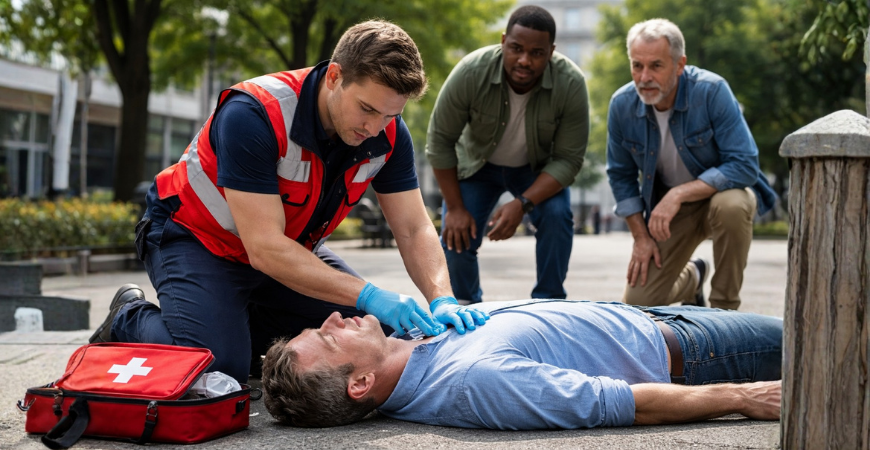
First Response Guidance
Emergencies don’t wait for professionals to arrive—they unfold in real time, often in front of unprepared eyes. In those critical first few moments, the actions taken by bystanders can determine the outcome. First Response Guidance is designed to transform hesitation into action, equipping individuals with the knowledge and confidence to respond effectively when every second counts.
Led by Dr. Kushal Narula, an experienced Emergency Physician and Assistant Professor, this service is built on real-world expertise, evidence-based practices, and a deep understanding of how emergencies evolve. It focuses not just on what to do—but how to think, react, and lead in high-pressure situations.
Why First Response Matters More Than Ever
In many emergency scenarios, the first responder is not a doctor—it’s a family member, colleague, or passerby. The time between the onset of an emergency and the arrival of medical professionals is often the most critical window.
First Response Guidance ensures that individuals:
- Recognize emergencies early and accurately
- Provide immediate care that stabilizes the patient
- Prevent complications before professional help arrives
- Act with clarity instead of panic
Dr. Kushal Narula emphasizes, “In emergencies, doing something right is far better than doing nothing perfectly.”
Beyond Basics: A Smarter Approach to Emergency Response
This program goes beyond traditional first aid training. It integrates modern medical knowledge with practical, easy-to-apply techniques that anyone can learn and remember.
Situational Awareness Training
Participants learn how to quickly assess their surroundings, identify risks, and prioritize actions. Whether it’s a road accident, sudden collapse, or choking incident, awareness is the first step toward effective intervention.
Decision-Making Under Pressure
Emergencies are chaotic. This module trains individuals to stay calm, think clearly, and make rapid decisions based on the situation at hand.
Step-by-Step Response Frameworks
Clear, structured approaches are taught for different emergency scenarios, ensuring that even under stress, actions remain organized and effective.
Core Areas Covered in First Response Guidance
This service is designed to address a wide range of real-life emergencies, making it relevant for both medical and non-medical individuals.
Cardiovascular Emergencies
Learn to पहचान early signs of heart attacks and cardiac arrest. Participants are trained in performing CPR, using automated external defibrillators (AEDs), and maintaining circulation until advanced care arrives.
Airway and Breathing Emergencies
Choking, asthma attacks, and respiratory distress require immediate attention. This module teaches techniques to clear airways and support breathing effectively.
Trauma and Injury Management
From road traffic accidents to falls, trauma situations are common. Learn how to control bleeding, immobilize injuries, and prevent shock.
Neurological Emergencies
Recognizing symptoms of stroke, seizures, and unconsciousness is critical. Quick response can significantly reduce long-term complications.
Everyday Emergencies
Burns, allergic reactions, poisoning, and heat-related illnesses are covered with practical, easy-to-follow guidance.
Practical Learning for Real-Life Confidence
First Response Guidance is not about memorizing steps—it’s about building confidence through practice.
Hands-On Training
Participants engage in realistic scenarios that simulate emergency situations. This helps build muscle memory and prepares them for actual events.
Visual and Interactive Learning
Simplified visuals, demonstrations, and interactive sessions make complex medical concepts easy to understand and retain.
Continuous Feedback and Improvement
Learners receive guidance on their performance, helping them refine their skills and gain confidence over time.
Designed for Everyone
One of the most powerful aspects of this service is its accessibility. You don’t need a medical background to save a life.
This program is ideal for:
- Students and educators
- Corporate teams and workplace staff
- Parents and caregivers
- Security personnel and public service workers
- Healthcare trainees seeking foundational emergency skills
Dr. Kushal Narula ensures that the training is tailored to suit different audiences, making it both practical and impactful.
The Science Behind First Response
Modern emergency medicine highlights the importance of early intervention. Studies consistently show that immediate first response significantly improves survival rates in conditions like cardiac arrest, trauma, and stroke.
This program integrates:
- Latest clinical guidelines
- Evidence-based protocols
- Real-world emergency case insights
As an Assistant Professor, Dr. Kushal Narula combines academic precision with frontline experience, ensuring that every piece of information is both accurate and applicable.
Building a Culture of Preparedness
First Response Guidance is not just a service—it’s a movement toward a more prepared and responsible society.
Imagine workplaces where employees can respond to medical emergencies confidently. Homes where family members know how to act during a crisis. Public spaces where bystanders become lifesavers.
This program aims to:
- Increase community awareness
- Reduce fear and hesitation
- Empower individuals to take responsibility
- Create safer environments everywhere
What Sets This Service Apart
- Expert-led training by an experienced emergency physician
- Real-life scenario-based learning
- Easy-to-understand, practical approach
- Focus on confidence-building and quick decision-making
- Updated medical knowledge aligned with current practices